GEOGRAPHY MYP/GCSE/DP
  • MYP
    • Development >
      • Billionaires investigation
      • An unequal world?
      • Africa: the danger of a single story
      • Patterns of development
      • Trade and development
      • Fair Trade
      • Sustainable Development Goals
    • Tectonic Hazards >
      • What is risk?
      • Alfred Wegener and Continental Drift
      • Plate tectonics
      • Distribution of tectonic hazards
      • Measuring earthquakes
      • Why do people die in earthquakes?
      • School earthquake plan
      • Earthquake assessment
      • Volcanoes - what are they? Why are they important?
      • Volcano "Science Fair"
      • Causes of tsunami
    • Population >
      • Why study population?
      • Population distribution
      • Population growth
      • Population pyramids
      • Demographic transition model
      • Migration
      • Migration examples - case studies
      • Refugees in Indonesia
      • Population revision activities
    • Weather and Climate >
      • Weather vs Climate and why is it important?
      • Climate graphs
      • Why does it rain?
      • What affects temperature and why is Jakarta so hot and wet?
      • What causes wind and how do we measure it?
      • Microclimates
  • Home
    • Contact
  • IGCSE
    • Course information
    • Physical: Hazardous environments >
      • Distribution of tectonic hazards
      • Causes of tsunami
      • Measuring earthquakes
      • Earthquake case study 1: Haiti
      • Earthquake case study 2: Christchurch
      • Why do earthquakes do more damage in LICs than in HICs?
      • How are volcanic eruptions measured?
      • Tropical storms - distribution
      • Causes of tropical cyclones
      • Tropical cyclones - case study
      • Why live in hazardous areas?
    • River Environments >
      • Hydrological cycle
      • River basins
      • Factors affecting river regimes
      • Fluvial processes: erosion
      • Fluvial processes: weathering and mass movement
      • Fluvial processes: transportation and depositon
      • River features and their formation
      • How rivers change from source to mouth
      • Uses of water
      • Water pollution
      • Water supply
  • IBDP
    • Changing population >
      • Global patterns of economic development
      • Physical and human factors affecting global population distribution
      • Case study 1: China
      • Case study 2: Niger
      • Demographic transition
      • Megacity growth
      • Forced migration and internal displacement
      • Ageing populations
      • Pro-natalist and anti-natalist policies
      • Gender equality policies
      • Trafficking policies
      • The Demographic Dividend
    • Global climate vulnerability and resilience >
      • Atmospheric system
      • The energy balance
      • Changes in the energy balance
      • The enhanced greenhouse effect
      • Climate Change and the Hydrosphere, Atmosphere and Biosphere
      • Impacts of climate change on people and places
      • Disparities in exposure to climate change risk and vulnerability
      • Government-led adaptation and mitigation strategies
      • Civil society and corporate strategies
    • Global resource consumption and security >
      • Progress towards poverty reduction
      • Measuring trends in global consumption
      • Global patterns and trends in the availability and consumption of water
      • Global patterns and trends in the availability and consumption of land/food
      • Global patterns and trends in the availability and consumption of energy
      • Water food and energy nexus
      • Recycling and waste
      • Malthus vs Boserup
      • Resource Stewardship strategies
      • Sustainable Development Goals
    • Freshwater - drainage basins >
      • The drainage basin as a system
      • How rivers change from source to mouth
      • River discharge
      • River processes
      • River landforms
      • Factors affecting flood risk
      • Attempts at flood prediction
      • Flood mitigation
      • Flood mitigation case studies
      • Water scarcity
      • Agricultural activities and water quality
      • Pressures on lakes and aquifers
      • Internationally shared water and conflict
      • Water management: participation of local communities
      • Dams as multi-purpose schemes
      • Water management: Integrated Drainage Basin Management (IDBM)
      • Managing wetlands
    • Leisure, Sport and Tourism >
      • Growth and purpose of leisure time
      • Categories of tourism and sport
      • Economic development and participation
      • Factors affecting personal participation
      • Factors affecting growth of tourism hotspots
      • Spheres of influencee
      • Factors affecting a national sports league
      • Festivals
      • Niche national tourism strategies
      • Role of TNCs
      • Tourism as a national development strategy
      • International sporting events
      • Consequences of unsustainable growth
      • Sustainable tourism
      • Future international tourism
      • Political and cultural influences on sport
    • Extended Essay in Geography >
      • Supervisor meetings
    • Skills/concepts >
      • Infographics
      • 4 Ps
      • Mock examination revision and preparation
  • Geography and ToK
  • Theory of Knowledge
    • Knowledge and Technology
    • Knowledge and Language
    • Knowledge and Politics
    • Knowledge and Religion
    • Knowledge and Indigenous Societies

​Global and regional/continental progress towards poverty reduction, including the growth of the “new global middle class”

Subject Guide

​Global and regional/continental progress towards poverty reduction, including the growth of the “new global middle class”
Ending poverty and hunger - how much do you know? Guardian quiz

1. What is poverty?

​There are many different types of poverty; three important types are briefly explained below:
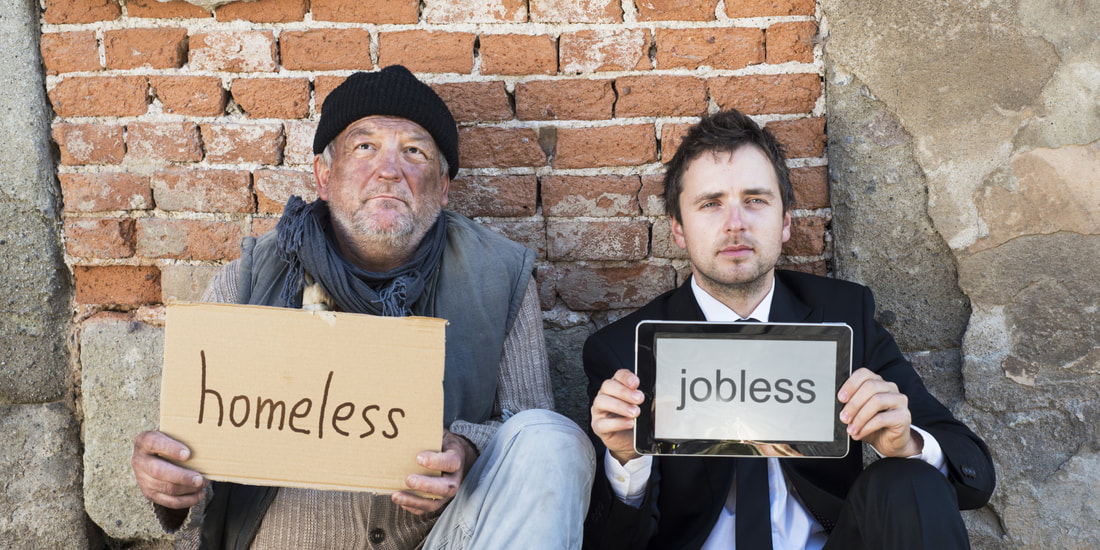
  1. Situational poverty is  caused by a sudden crisis or loss and is often temporary. Causes might include environmental disasters, divorce, or severe health problems.
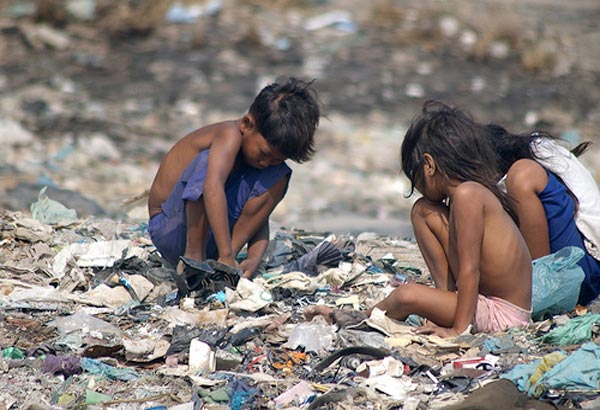
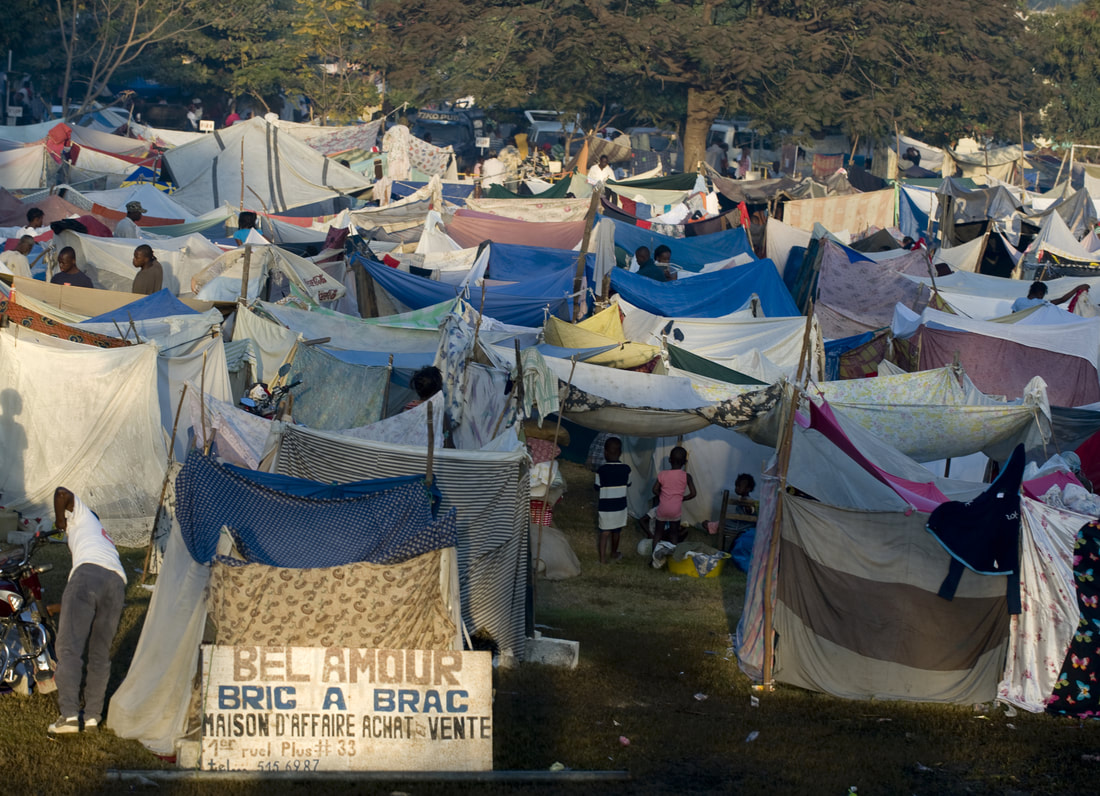
  2. Absolute poverty involves a lack of basic needs such as shelter, clean water, and food. People in absolute poverty will probably focus on day-to-day survival.
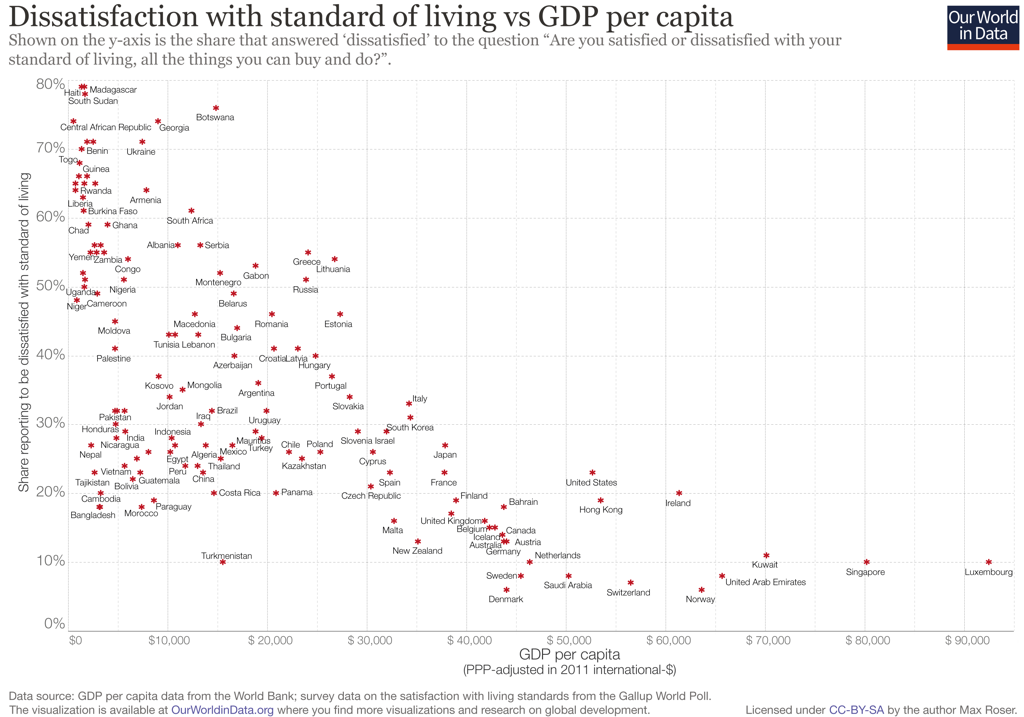
  3. Relative poverty is where people's incomes fall significantly below the average for the place where they live. They may have access to basic needs and more but will be poorer than other people and families in the same place.
Picture
Picture
Absolute poverty
Picture
Relative poverty
Picture
What is the poverty line or poverty threshold?
​This is a level defined by national governments or economists to identify the minimum income needed to be able to access the necessities of life.

This threshold will be vary widely between countries because of how much can be purchased with a given amount of money in that place. For example the poverty level for a single person in the US is currently $12, 240 per year or $33 a day (2018). The equivalent for India is $0.40 for urban dwellers and $0.25 for rural dwellers. The World Bank sets the world poverty threshold at $1.90 a day.

2. How are global patterns of poverty changing?

Use the graph on the left (or the one in your textbook p234) to identify and describe changing patterns of poverty worldwide. You should consider:
  • ​Overall trends - look at the global figures and describe the overall trends for each region.
  • Relative figures globally - in 1980 which regions had most and least poverty? How does this change between 1980 and the present day.
  • Which regions have seen the greatest reduction in poverty?
  • Which regions are reducing poverty most slowly?
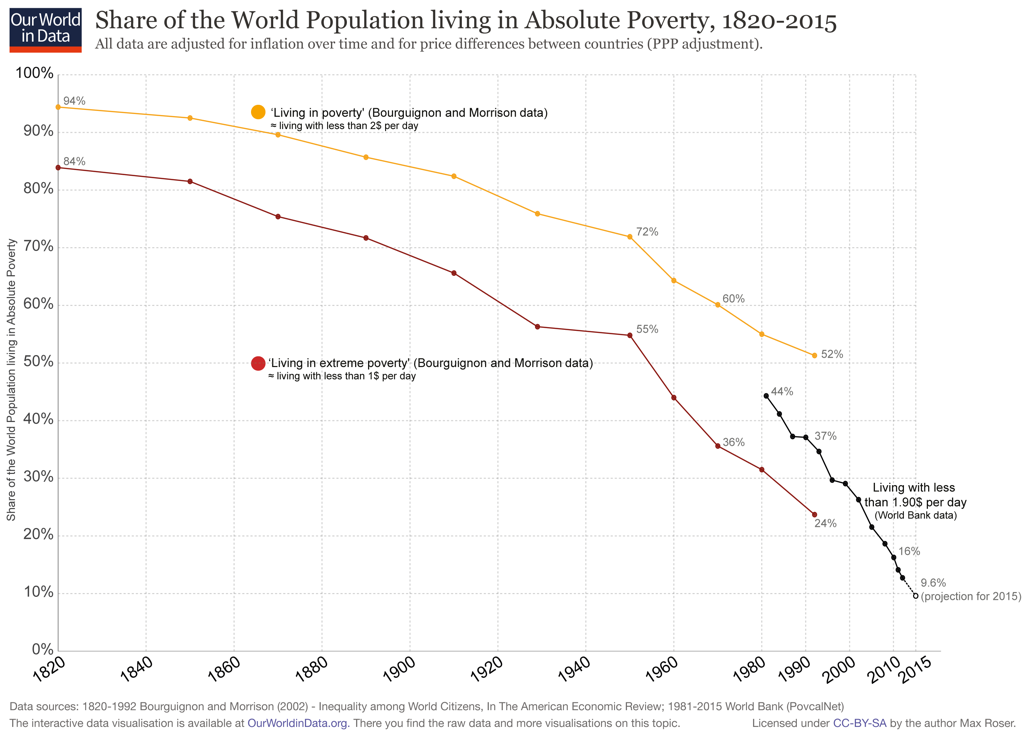
The global economy has grown rapidly since the 1950s, at a rate much faster than population growth. Since the MDGs were introduced in 2000, global poverty has halved. The most rapid progress has been made in Asia, but as the World Bank data shows, progress has been made in all global regions (NB this is not the same as saying that progress has been made in all countries - what might be the exceptions?).

Poverty does remain widespread in many areas of southern Asia and in Sub-Saharan Africa.
Picture


​The Magic Washing Machine - Hans Rosling
  • Why does Rosling identify the washing machine as a significant indicator?
  • What does the video tell us about changing levels of global poverty/inequality?


Yes They Can!
  • What is the key message here?
  • What does it say about the potential for economic growth and development of the LICs?

3. The New Global Middle Class

Traditionally the term "middle class" has been used to describe a socio-economic group between the workers (working class) and the elite workers and capitalists  (ruling class or bourgeoisie). 

The term "new global middle class" is used to refer to the growing number of people worldwide who have moved out of poverty and who have "discretionary income" (money that is not needed to provide basic needs). This money can be spent on consumer goods, health care and, at the upper end, holidays and cars. 

Definitions vary but a common one is 
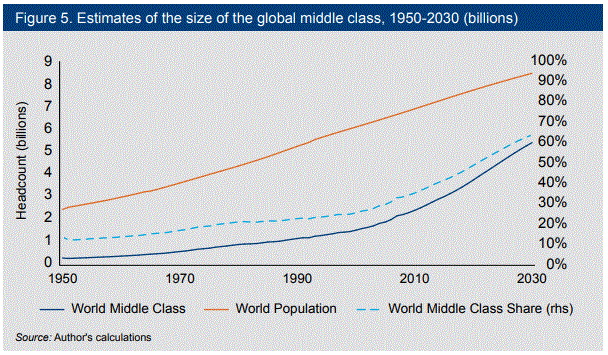
those households with per capita incomes between $10 and $100 per person per day (pppd) in 2005 PPP terms. This implies an annual income for a four-person middle-class household of $14,600 to $146,000. Clearly, this means that there is huge variation within the NGMC.
Picture
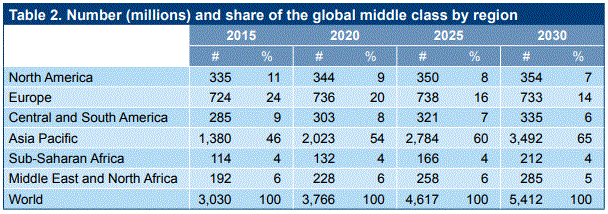
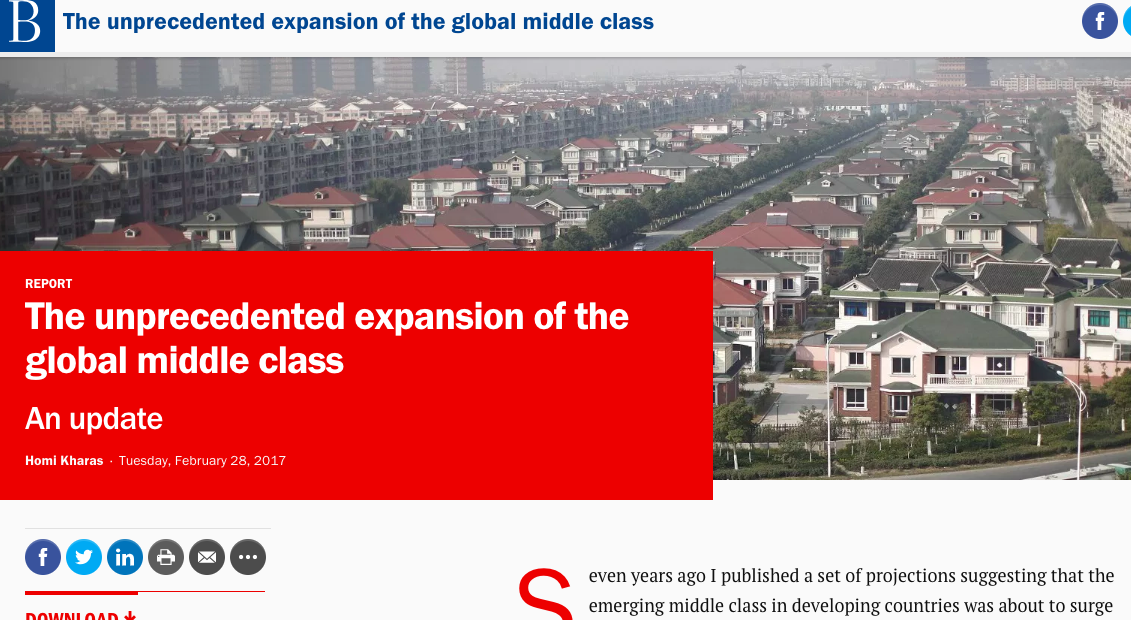
From THE UNPRECEDENTED EXPANSION OF THE GLOBAL MIDDLE CLASS AN UPDATE by Homi Kharas


  • Describe the growth in the Global Middle Class from 1950 to the present day.
  • What do projections suggest about future growth?
  • Can you suggest any factors that might limit the growth of the NGMC in future?

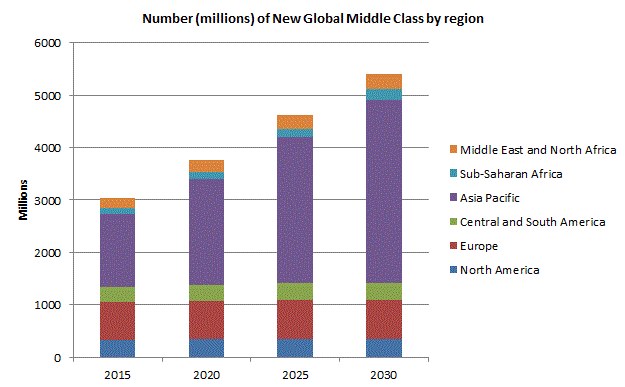
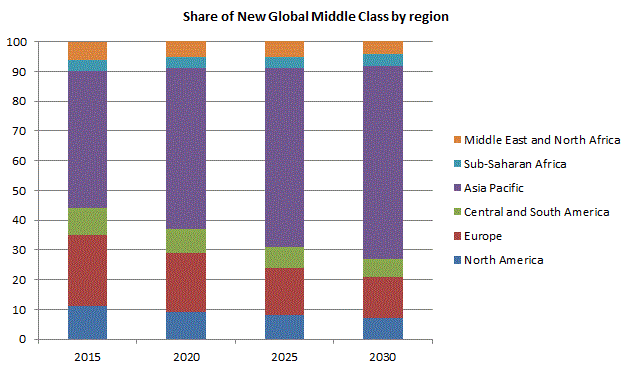
Study the data and the graphs on the number and share of GNMC by region.
  • What patterns are shown? Start with global trends and then examine patterns for N.America and Europe cf Asia Pacific cf Sub-Saharan Africa.
  • Why is it important to examine share as well as overall number?
Picture
growth_of_new_global_middle_class.xlsx
File Size: 11 kb
File Type: xlsx
Download File

Picture
Picture
Picture
unprecedented_rise_of_the_globa__middle_class.pdf
File Size: 1117 kb
File Type: pdf
Download File

  • MYP
    • Development >
      • Billionaires investigation
      • An unequal world?
      • Africa: the danger of a single story
      • Patterns of development
      • Trade and development
      • Fair Trade
      • Sustainable Development Goals
    • Tectonic Hazards >
      • What is risk?
      • Alfred Wegener and Continental Drift
      • Plate tectonics
      • Distribution of tectonic hazards
      • Measuring earthquakes
      • Why do people die in earthquakes?
      • School earthquake plan
      • Earthquake assessment
      • Volcanoes - what are they? Why are they important?
      • Volcano "Science Fair"
      • Causes of tsunami
    • Population >
      • Why study population?
      • Population distribution
      • Population growth
      • Population pyramids
      • Demographic transition model
      • Migration
      • Migration examples - case studies
      • Refugees in Indonesia
      • Population revision activities
    • Weather and Climate >
      • Weather vs Climate and why is it important?
      • Climate graphs
      • Why does it rain?
      • What affects temperature and why is Jakarta so hot and wet?
      • What causes wind and how do we measure it?
      • Microclimates
  • Home
    • Contact
  • IGCSE
    • Course information
    • Physical: Hazardous environments >
      • Distribution of tectonic hazards
      • Causes of tsunami
      • Measuring earthquakes
      • Earthquake case study 1: Haiti
      • Earthquake case study 2: Christchurch
      • Why do earthquakes do more damage in LICs than in HICs?
      • How are volcanic eruptions measured?
      • Tropical storms - distribution
      • Causes of tropical cyclones
      • Tropical cyclones - case study
      • Why live in hazardous areas?
    • River Environments >
      • Hydrological cycle
      • River basins
      • Factors affecting river regimes
      • Fluvial processes: erosion
      • Fluvial processes: weathering and mass movement
      • Fluvial processes: transportation and depositon
      • River features and their formation
      • How rivers change from source to mouth
      • Uses of water
      • Water pollution
      • Water supply
  • IBDP
    • Changing population >
      • Global patterns of economic development
      • Physical and human factors affecting global population distribution
      • Case study 1: China
      • Case study 2: Niger
      • Demographic transition
      • Megacity growth
      • Forced migration and internal displacement
      • Ageing populations
      • Pro-natalist and anti-natalist policies
      • Gender equality policies
      • Trafficking policies
      • The Demographic Dividend
    • Global climate vulnerability and resilience >
      • Atmospheric system
      • The energy balance
      • Changes in the energy balance
      • The enhanced greenhouse effect
      • Climate Change and the Hydrosphere, Atmosphere and Biosphere
      • Impacts of climate change on people and places
      • Disparities in exposure to climate change risk and vulnerability
      • Government-led adaptation and mitigation strategies
      • Civil society and corporate strategies
    • Global resource consumption and security >
      • Progress towards poverty reduction
      • Measuring trends in global consumption
      • Global patterns and trends in the availability and consumption of water
      • Global patterns and trends in the availability and consumption of land/food
      • Global patterns and trends in the availability and consumption of energy
      • Water food and energy nexus
      • Recycling and waste
      • Malthus vs Boserup
      • Resource Stewardship strategies
      • Sustainable Development Goals
    • Freshwater - drainage basins >
      • The drainage basin as a system
      • How rivers change from source to mouth
      • River discharge
      • River processes
      • River landforms
      • Factors affecting flood risk
      • Attempts at flood prediction
      • Flood mitigation
      • Flood mitigation case studies
      • Water scarcity
      • Agricultural activities and water quality
      • Pressures on lakes and aquifers
      • Internationally shared water and conflict
      • Water management: participation of local communities
      • Dams as multi-purpose schemes
      • Water management: Integrated Drainage Basin Management (IDBM)
      • Managing wetlands
    • Leisure, Sport and Tourism >
      • Growth and purpose of leisure time
      • Categories of tourism and sport
      • Economic development and participation
      • Factors affecting personal participation
      • Factors affecting growth of tourism hotspots
      • Spheres of influencee
      • Factors affecting a national sports league
      • Festivals
      • Niche national tourism strategies
      • Role of TNCs
      • Tourism as a national development strategy
      • International sporting events
      • Consequences of unsustainable growth
      • Sustainable tourism
      • Future international tourism
      • Political and cultural influences on sport
    • Extended Essay in Geography >
      • Supervisor meetings
    • Skills/concepts >
      • Infographics
      • 4 Ps
      • Mock examination revision and preparation
  • Geography and ToK
  • Theory of Knowledge
    • Knowledge and Technology
    • Knowledge and Language
    • Knowledge and Politics
    • Knowledge and Religion
    • Knowledge and Indigenous Societies